



ANTI-POVERTY PSA CAMPAIGN CASE HISTORY

Children make up less than 30 percent of the population of the United States, but they’re 100 percent of our future. Yet, right now, more than 12,000,000 precious dreams of a better tomorrow are being threatened by a struggle to secure enough food, shelter and medical attention to survive. According to the Census Bureau, one out of every six children, or 16 percent of all the children in America, is living in a state of poverty. Overall, more than 31 million Americans live in poverty today - a population greater than the state of Texas, Florida or New York combined, but you won’t find it on any map. Despite the fact that America’s economy has been thriving in recent years, our child poverty rate is higher than most other industrialized nations, according to UNICEF. In spite of these grim statistics, a March 2000 Gallup poll found that only 5% of Americans believe poverty and homelessness are important problems for the country.

For more than 30 years, the Catholic Campaign for Human Development has dedicated itself to educating the general public about the struggle of the poor in the United States, as well as supporting grass roots programs that permanently break the cycle of poverty in communities. Last January, CCHD launched its first national multimedia campaign that focused public attention on the 32 million Americans living below the poverty line and helped Americans grasp the magnitude of the problem by suggesting that if we were to move all of our nation’s 'poor' into a single state, it would become our second largest state, just slightly smaller than California!

Called "Poverty USA. America's Forgotten State," the campaign’s powerful graphics, created by Crosby Marketing Communications of Annapolis, MD., has won major national creative awards including the Axiem Award for Absolute Excellence in Electronic Media. More than 1,500 entries from all 50 states and several countries were received in the international awards program recognizing excellence in television, film, audio, video, radio, animation, the World Wide Web and interactive media. The campaign’s compelling creative materials makes current statistics memorable and drive home an important message: We must not forget America’s poor. The theme and a similar color schematic were extended across all the materials distributed to the media to tie the campaign together and create memorability.


Four-color box labels were applied to the corrugated shipping boxes used to send TV PSAs to stations and a 4/c storyboard with the letter incorporated into the design was used to show public service directors the creative content of the PSAs.

A custom radio packaging concept called Radio DiskPac was used to distribute radio PSAs to stations and the package included a script booklet with live announcer copy and facts on the issue of poverty. PSAs were sent in both English and Spanish versions.

Print PSAs were sent to 5,600 daily and weekly newspapers and a custom list of 2,000 consumer, professional and trade magazines. To make it easy to review and use the PSAs, a “book” of print PSAs was designed with a perforation for each page of PSAs and a business reply card for ordering special materials was included in the print PSA package.

Community Outreach

One of the biggest challenges of distributing the campaign was the need to be able to break out distribution lists of all media by 178 Catholic dioceses located in communities across America. To accomplish this task, Goodwill Communications purchased a database of every U.S. zip code that had also had counties for each zip. We then had to write custom software to assign each zip code and county to a unique diocese and match that database against our 30,000 master media database. The end result permits public outreach specialists in each diocese to see precisely which media outlets in their particular geographic territory received the poverty PSAs and the previous usage practices for all the media outlets.

Using a unique targeting system called the “Previous Usage Index” for each media outlet, CHD community partners could easily see which media outlets have used other client PSAs and those that have or have not used theirs. Media lists could also be easily downloaded to develop customized media contact lists for each diocese across the country.

Other components of the campaign include a content-rich website, found at www.povertyusa.org. The site provides access to a guided Poverty Tour, educational facts and ideas for how people can act to end poverty in their own communities. It also allows public service directors to preview the campaign and order materials.

Evaluation

Recap of Evaluation Methodology

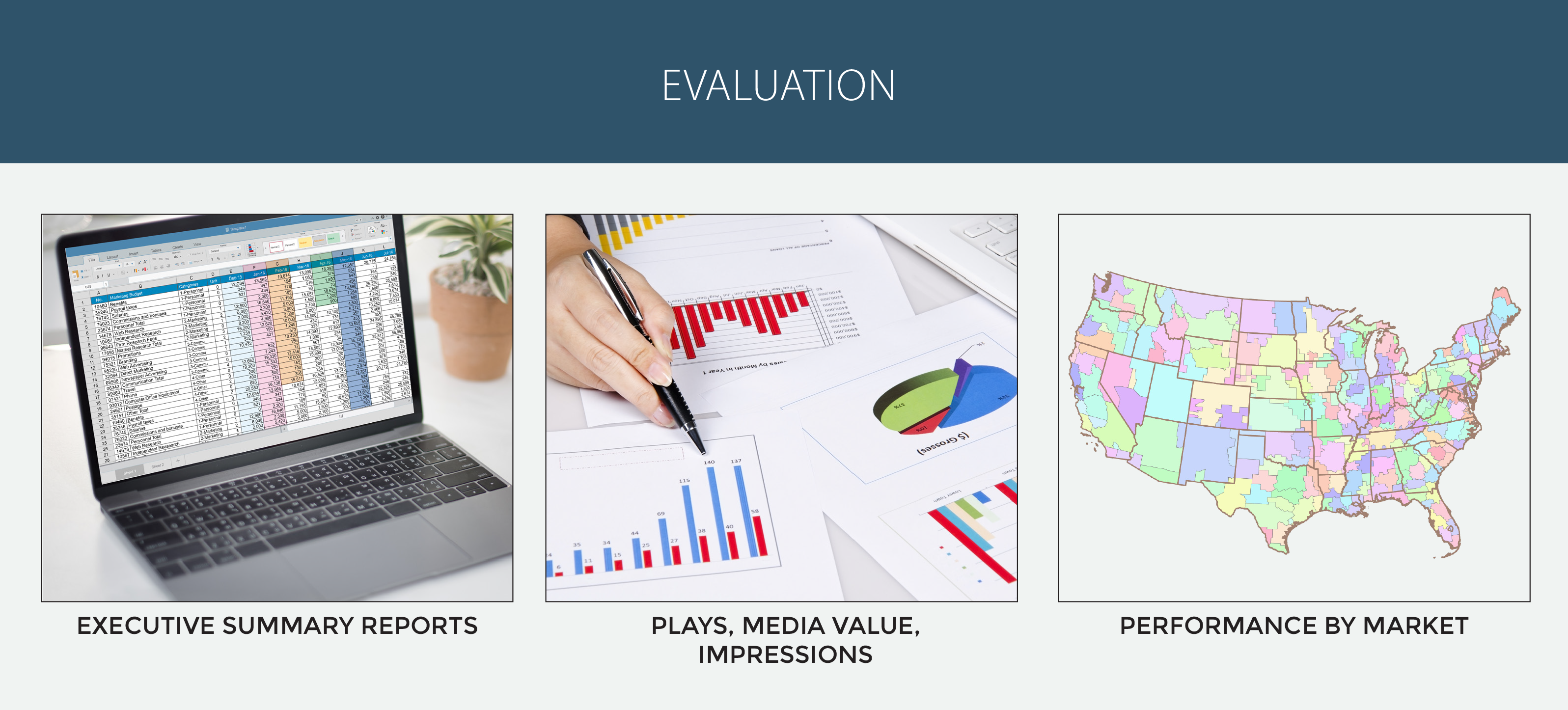
The A.C. Nielsen SIGMA electronic tracking system is the primary method that is used to evaluate the usage of all TV PSAs that Goodwill Communications distributes. Additionally, we use evaluation bounce-back cards to capture usage on local cable outlets that SIGMA does not track and to capture usage from stations that, for one reason or another, indicate their intention to use PSAs, but are not reported by the SIGMA system. While the SIGMA code is placed on the tape where stations are not supposed to do any editing, these situations can occur if stations do anything to the ending frame of the PSA, or edit the PSA in any manner. To cover these situations, our evaluation methodology gives clients credit for usage that stations report on bounce-back cards and for which we did not receive a SIGMA detection. To distinguish this exposure from SIGMA detections that we know have occurred, we give our clients credit usage from business reply cards (BRCs) and label it as “Projected Usage” on our evaluation reports.

The data in this case history report results from ten months of tracking with two more to go until evaluation is complete. The following table shows the key evaluation statistics for the 2000 Poverty campaign:

“Poverty USA” – 6TH REPORT
  SIGMA TV   
STATES CITIES STATIONS PLAYS VALUE 
51 314 562 28,464 $4,679,619 
  BRC TV  $ 384,217 
  RADIO   
49 333 512 58,410 $ 975,681 
  PRINT (PUBS) CIRCS*  
40 152 186 7,538 $ 135,345 
TOTAL    $6,174,862 
*In thousands

TOTAL VALUES

The Poverty USA campaign has generated just over $6 million in advertising equivalency exposure as shown in the graph. The TV PSAs also received national exposure via the season premier of NYPD Blue and were aired on ABC and CBS network affiliates from network feeds. Of the TV total, just under $450,000 in exposure was on Spanish stations.

Benchmark Comparisons

As another qualitative evaluation method, we have developed TV PSA benchmark data that uses exposure from 41 different PSAs we have distributed in the past two years. All of the campaigns in the benchmark data set were distributed to a similar number of TV stations and were tracked using the A.C. Nielsen SIGMA monitoring service. Each month, we compile the data for the campaigns so we can compare any given campaign to the benchmark. As shown in the graph, the Poverty PSA exceeded the benchmark by 22 percent at the tenth month of tracking.

Benchmark ComparisonsUsage By Spot Length

Many PSA clients make the mistake of not producing longer length PSAs and this graph clearly shows the importance of having both a good mixture of spot lengths and a longer length execution.

For the Poverty campaign, just under 40 percent of all exposure was generated by the :60 second spot. This is a very positive trend in that it we can communicate a more compelling message than is possible with a shorter length spot and allows us a longer period to show the call to action on the ending tag.

Usage By Daypart

As another quality measurement, we break SIGMA data out by six different dayparts as shown here. For the CCHD campaign, nearly two-thirds of all plays occurred during the best dayparts – from the last half of the Early Morning time frame to the first half of the Late Evening daypart.

Usage By Network Affiliates

Still another qualitative measurement is the number of network affiliate stations that use PSAs, since network affiliates generally have larger audiences than independents. For the CCHD TV PSA, 80 percent of all usage occurred on network affiliates, and nearly two-thirds of the plays occurred on the “big three.” network affiliates. It is also interesting to note that both ABC and CBS fed the PSA to their affiliates, while NBC did not. For ABC, 166 affiliates used the Poverty PSA and for CBS 180 stations used it. For NBC, only 44 reported using it, even though their values exceeded or matched the other two. This demonstrates how important it is to encourage network feeds. The values for Independent stations include $226,250 in usage among Spanish language stations.

Top Markets

Just over half of all broadcast usage occurred in the top 100 markets which is where 86% of all U.S. TV households are located.

Usage By Regions

This graph shows usage by different geographic regions of the U.S. and as it shows, usage is way below norm in the south. Perhaps the good news to this trend is that most of the smaller media markets are in that region, but it does provide the basis for some possible corrective strategy for the 2002 campaign.

Radio Usage By Format

This graph shows the top three radio formats that used the Poverty PSAs as well as Spanish usage. To some degree this reflects the fact that there are a lot more Adult Contemporary and Country/Western stations in the U.S. than any other format. These two formats, for example, account for nearly half of all the stations to which the Poverty PSAs were distributed.

Radio Benchmark

The Poverty campaign performed ten percent above the benchmark, which is comprised of 24 different campaigns we’ve distributed to a similar number of stations and the PSAs were broadcast on four radio networks. Shown here are some of the best performing campaigns as a basis of comparison.

Print Usage By Type

Typically magazines contribute a much larger percentage of total print value than has occurred to date for the Poverty campaign. Even after the release of the 2002 campaign however, clips from the 2001 release will continue to be evaluated.

The One In Six Campaign

Building on the success of its “Poverty USA” campaign, CCHD launched a second wave of the poverty campaign to coincide with Poverty in America Awareness Month. The new campaign, titled “One in Six Children Lives in Poverty USA,” was also created by Crosby Marketing and was distributed by Goodwill Communications to over 14,000 broadcast television, radio and print outlets across the country. The PSAs were created to help call attention to the enormous number of children in America still living in need.

The campaign generated 84,622 total plays on 1,008 media outlets and accounted for just under $6 million in advertising support.

The Catholic Campaign for Human Development, the campaign sponsoring organization, was established by the United States Conference of Catholic Bishops, a non-profit and tax-exempt organization. As one of the nation s largest funding organizations for self-help programs for the poor, CCHD has helped support more than 4,000 projects nationwide that know no racial or religious boundaries - projects that help create jobs, improve neighborhoods and much more - projects that help people find a way out of poverty not just for a day, but a lifetime.

For more program information, contact Charles Evans at the Catholic Campaign for Human Development at 202-541-3364 or cevans@usccb.org. For information on the creative strategy, contact Raymond Crosby at 410-626-0805 or raycrosby@crosbymarketing.com. For information on distribution or evaluation, contact Bill Goodwill, 954-533-3978 or bgoodwill@goodwillcommunications.com.